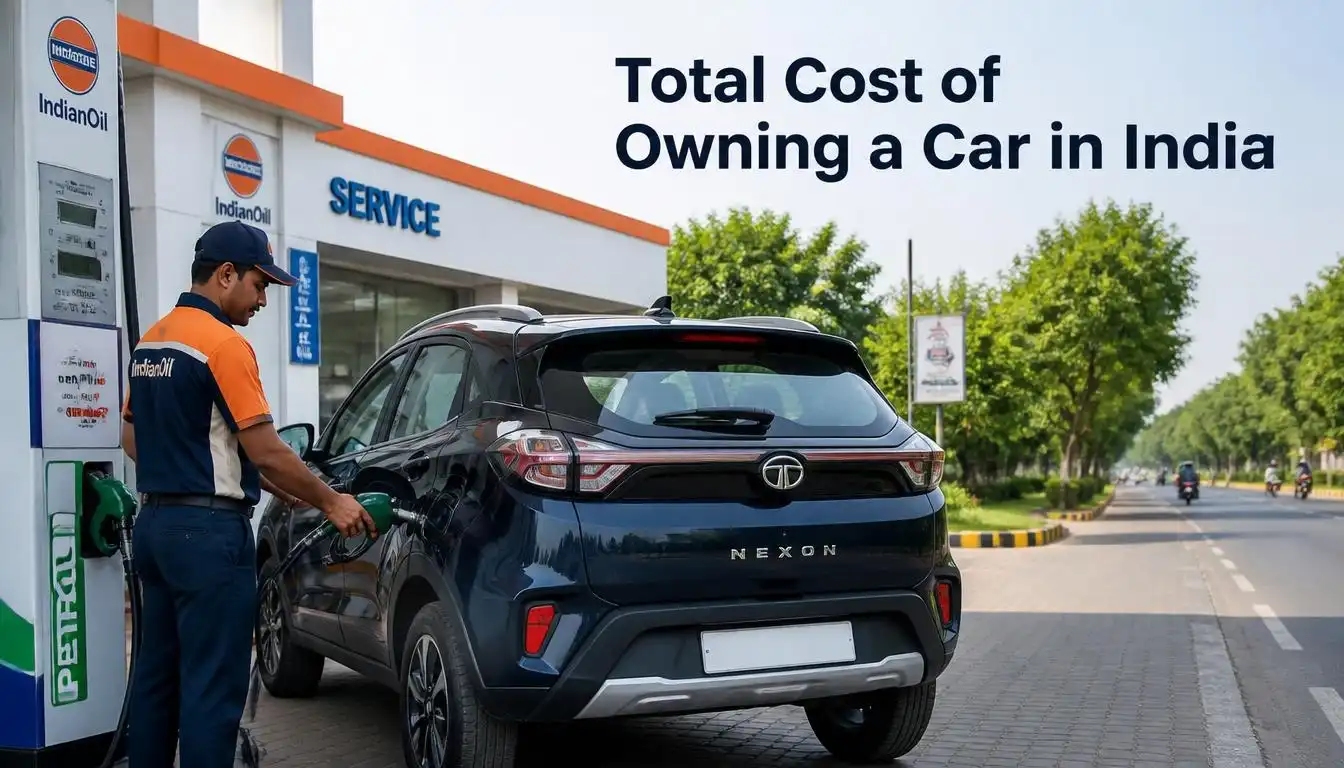
Most buyers judge a car by one number: the monthly EMI. But the EMI is only part of the cost — fuel, insurance, servicing, road tax and depreciation together can easily match the EMI itself.
So work out the total cost of ownership: everything you will spend over the years you keep the car, not just the loan repayment.
Why the EMI Is Only Part of the Cost
An EMI covers only the loan and its interest — not a litre of petrol, an insurance premium, or a service bill. Yet many buyers compare cars only by EMI, then feel squeezed when the real monthly spend turns out much higher.
Ownership has three parts: fixed costs (EMI, insurance, road tax), running costs (fuel, servicing, repairs), and depreciation — the value lost each year. Budget for all three: as a rule, add 30 to 40 percent on top of the EMI for running and maintenance.
1. The EMI
The EMI is usually the biggest monthly cost, set by the on-road price, down payment, tenure and rate. A longer tenure lowers the EMI but raises total interest — a “cheap” EMI can be expensive.
On a loan of Rs. 6,00,000 at an illustrative rate of 9% per year for 5 years, the EMI is roughly Rs. 12,500 a month and the total interest is about Rs. 1,50,000. These are illustrative figures only — check current terms with your lender. Keep all your loan EMIs within about 40 percent of your monthly income.
2. Fuel
Fuel is usually the second-biggest cost, set by mileage, fuel price and distance driven.
A petrol car giving 15 km per litre and running 1,000 km a month needs about 67 litres a month. At an illustrative fuel price of Rs. 100 per litre, that is about Rs. 6,700 a month — more than half the EMI in the example above. A diesel or CNG car may cost less per kilometre, while a large petrol SUV can cost much more.
Check real-world mileage from owner reviews before buying — at 2,000 km a month, mileage should top your list.
3. Insurance
Car insurance is compulsory in India, and for a financed car it is also required by the lender — a new car usually comes with a bundled first-year policy.
A comprehensive policy for a mid-range car can cost roughly Rs. 15,000 to Rs. 30,000 a year, depending on the car’s value, your city, the add-ons and your claim history. A no-claim bonus can bring the premium down over the years if you do not make claims.
Add-ons like zero depreciation raise the premium but can save a lot in a claim. Compare on coverage, not just price, and renew on time.
4. Maintenance and Service
Regular servicing — oil, filters, coolant, brake pads and checks — costs a small hatchback about Rs. 5,000 to Rs. 8,000 a year, and a premium car two or three times as much.
Then come the costs of age: tyres every 40,000 to 50,000 km, a battery every three to four years, clutch and suspension work, and the occasional unexpected repair. Budgeting about Rs. 1,000 to Rs. 2,000 a month for maintenance and repairs is a reasonable starting point for a mid-range car.
5. Road Tax and Registration
Road tax and registration are one-time costs, roughly 8 to 20 percent of the ex-showroom price depending on the state. On an Rs. 8,00,000 car, that adds roughly Rs. 80,000 to Rs. 1,20,000 — so always compare on-road prices, not ex-showroom prices.
6. Depreciation — The Silent Cost
Depreciation is the value your car loses each year — typically 15 to 20 percent in the first year, then roughly 10 percent a year. A car bought for Rs. 8,00,000 may be worth only Rs. 4,50,000 to Rs. 5,00,000 after five years.
You do not pay depreciation monthly, so it is easy to ignore — but it is a real cost. It matters most if you sell within a few years, and least if you keep the car for a decade. Popular models with strong resale demand lose value more slowly, so check resale value before you buy.
A Worked Example: 5-Year Total Cost
Here is an illustrative example for a mid-range petrol hatchback — all figures are assumptions only.
Assumptions: on-road price Rs. 9,00,000; loan Rs. 7,20,000 at an illustrative 9% for 5 years; 1,000 km a month; 16 km per litre; fuel Rs. 100 per litre.
| Cost | 5-year total (illustrative) |
|---|---|
| EMI payments (principal + interest) | Rs. 8,97,000 |
| Fuel | Rs. 3,75,000 |
| Insurance (5 years) | Rs. 1,00,000 |
| Maintenance and repairs | Rs. 75,000 |
| Tyres and battery | Rs. 35,000 |
| Total cash spent in 5 years | Rs. 14,82,000 |
That is about Rs. 24,700 a month — nearly double the EMI of roughly Rs. 14,950. After the Rs. 4,50,000 resale value, the real 5-year cost is about Rs. 10,32,000. The EMI is barely half the story.
How to Reduce the Cost of Owning a Car
- Match the car to your running. Low running? A petrol hatchback is fine. High running? Better mileage, diesel or CNG may save more than the higher purchase price.
- Keep the loan tenure short. A 3-year loan has a higher EMI, but you pay far less interest overall.
- Make a bigger down payment if you can. It cuts the loan, the EMI and the interest in one stroke.
- Service on schedule. Skipping services saves money today and costs far more later, and a full service history protects resale value.
- Drive smoothly. Gentle driving improves mileage and makes brakes, tyres and the clutch last longer.
- Compare insurance every year. A quick comparison can save thousands, and a no-claim bonus is worth protecting.
FAQs
What is the total cost of owning a car in India?
The EMI plus fuel, insurance, maintenance, road tax and depreciation. For a mid-range car, the monthly total is often 1.5 to 2 times the EMI alone.
Is the EMI the biggest cost of owning a car?
Usually yes month to month, but fuel and depreciation are close behind. Over five years, fuel and depreciation together often exceed the total interest paid on the loan.
How much should I budget for car maintenance per month?
For a mid-range car, roughly Rs. 1,000 to Rs. 2,000 a month for servicing and repairs, plus extra for tyres and a battery as the car ages.
Does a diesel car cost less to own than a petrol car?
It can, if you drive a lot, since diesel gives better mileage. But diesel cars cost more to buy and service, so for low running petrol may be cheaper.
How does depreciation affect the cost of ownership?
A car loses value every year, typically 15 to 20 percent in the first year. Popular models lose value more slowly, lowering your true cost when you sell.
Conclusion
A car is affordable only when the full cost fits your budget — not just the EMI. Before you buy, add up the EMI, fuel, insurance, servicing and depreciation, and check whether the monthly total still feels comfortable. If not, a smaller car, a bigger down payment or a shorter loan may be smarter.
Disclaimer: This article is for educational and informational purposes only and is not financial advice. All prices, rates and figures are illustrative examples. Actual costs vary by car, city, lender, fuel price and usage — please check current terms and prices before making a decision.