
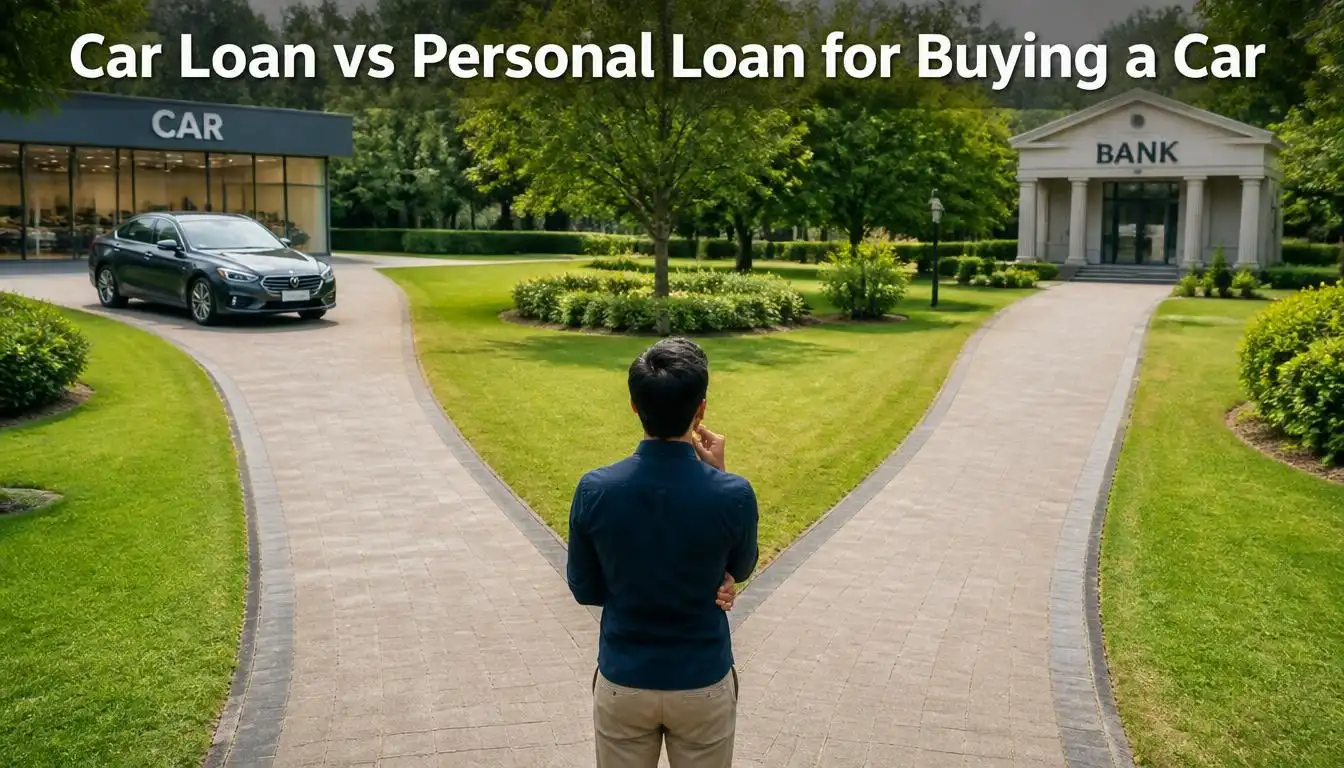
If you plan to buy a car without paying the full price in cash, you will usually face two choices: a car loan and a personal loan. Both give you money to buy the car, but they work in very different ways. A car loan is made only for buying a vehicle, while a personal loan can be used for almost anything.
The cheaper option depends on the rate, amount, tenure, and charges. This guide explains how each loan works, compares them, and works through an example.
How a Car Loan Works
A car loan is a secured loan. The car you buy acts as security for the lender. If you do not repay the loan, the lender has a legal right over the car. Because the lender has this security, car loans usually come with a lower interest rate than unsecured loans.
You normally pay a down payment. For example, on a Rs. 10,00,000 car financed at 90%, you pay Rs. 1,00,000 and borrow Rs. 9,00,000. The lender may pay the dealer directly.
Car loans usually run for one to seven years. The car is registered in your name, but the lender is also recorded as the financier until the loan is closed. After full repayment, get a No Objection Certificate from the lender and remove the financier’s name.
How a Personal Loan Works
A personal loan is an unsecured loan. You do not need to give any security or asset to the lender. You can use the money for a car, a holiday, a wedding, medical expenses, or any other personal need. The lender does not ask what you are buying.
Because there is no security, the lender takes more risk, so personal loans usually have a higher interest rate. The rate depends on your credit score, income, job stability, and existing loans.
Personal loans usually run for one to five years, and the amount is often lower. The main advantage is flexibility: you own the car fully from day one, and you can buy from a private seller, which is sometimes difficult with a car loan.
Car Loan vs Personal Loan: Comparison
| Factor | Car Loan | Personal Loan |
|---|---|---|
| Purpose | Only for buying a car | Any personal purpose |
| Security | Secured by the car | Unsecured |
| Interest rate, in general | Usually lower | Usually higher |
| Tenure | Usually 1 to 7 years | Usually 1 to 5 years |
| Loan amount | Often up to 90% of the price, subject to eligibility | Depends on income and credit score |
| Down payment | Usually required | Not required by the lender |
| Documents | Car quotation and dealer documents needed | Simpler, no car documents needed |
| Prepayment | Charges may apply, as per the terms | Charges may apply, as per the terms |
| Ownership | Financier recorded until the loan closes | You own the car fully from the start |
Worked Example: Total Cost for the Same Amount
Let us compare the total cost with a simple illustrative example. These figures are examples only, to show how interest works. They are not current bank rates, and your actual rate will be different.
Assumptions: loan amount Rs. 8,00,000, tenure 5 years (60 months), car loan rate in the example 9% per year, personal loan rate in the example 13% per year, and no processing fee or other charges in this simple calculation.
Using the standard EMI formula, the monthly EMI is about Rs. 16,606 for the car loan at 9%, and about Rs. 18,213 for the personal loan at 13%. Over five years, the total amount paid is about Rs. 9,96,360 for the car loan and about Rs. 10,92,780 for the personal loan. Total interest is therefore about Rs. 1,96,360 for the car loan and about Rs. 2,92,780 for the personal loan.
In this example, the personal loan costs about Rs. 96,420 more in interest for the same amount and tenure. Also check processing fees and prepayment charges, because a low rate with high charges is not always cheapest. Repeat this calculation with the rates offered to you, keeping amount and tenure the same.
When Might a Personal Loan Make Sense?
A personal loan can make sense in a few situations. First, if you are buying from a private seller, a car loan may be harder to get. Some lenders finance only dealer purchases, or only cars below a certain age. A personal loan gives you cash in hand, so you can buy from anyone.
Second, if you want a very old car or a low-value car, a lender may not offer a car loan for it. A personal loan does not depend on the car, so its age and value do not matter to the lender in the same way.
Third, if you need money quickly, a personal loan is simpler and often faster. If you have an excellent credit score and get a personal loan at a rate close to a car loan rate, the difference may be small.
When Is a Car Loan Usually Cheaper?
A car loan is usually cheaper when you buy a new car, or a used car that meets the lender’s rules, from a dealer. The lower interest rate is the biggest reason. Over a long tenure, that lower rate saves a lot of money.
It is also usually better if you want a longer tenure and lower EMI. Car loans often allow up to seven years, while personal loans often stop at five years. A longer tenure lowers the EMI but increases total interest.
Compare the total cost, not just the EMI. A lower EMI can look attractive, but with a longer tenure you may pay more interest in total. Ask for all charges in writing before you sign.
FAQs
Is a car loan always cheaper than a personal loan?
In most cases, yes, because a car loan is secured by the car and usually has a lower interest rate. If you get a personal loan at a rate very close to a car loan rate, the difference may be small.
Can I use a personal loan to buy a car?
Yes. You will own the car fully from the start, and the lender will not be recorded as a financier.
Which loan is easier to get?
A personal loan is often simpler because it does not need car documents. Approval for both depends on your credit score, income, and repayment history.
Can I get a car loan for a used car?
Yes, but the rules differ: the car’s age, value, and condition matter, and tenure and amount may be lower than for a new car. A personal loan is an alternative if a used car loan is not available.
Should I choose a loan only by the interest rate?
No. Also check fees, prepayment and foreclosure charges, and tenure. A slightly higher rate with no prepayment charge may work out better if you plan to repay early.
Conclusion
For most buyers, a car loan is cheaper, mainly because the rate is usually lower. A personal loan is more flexible for private purchases and older cars, but it usually costs more in interest.
Before you decide, get both offers in writing, compare rate, EMI, tenure, fees, and charges, and calculate the total amount you will pay. Choose the lowest total cost with an EMI you can pay comfortably.
Disclaimer: This article is for educational and informational purposes only. It is not financial advice. Rates, eligibility, and charges vary by lender and change over time. Please check the current terms with your lender before taking a loan.









