
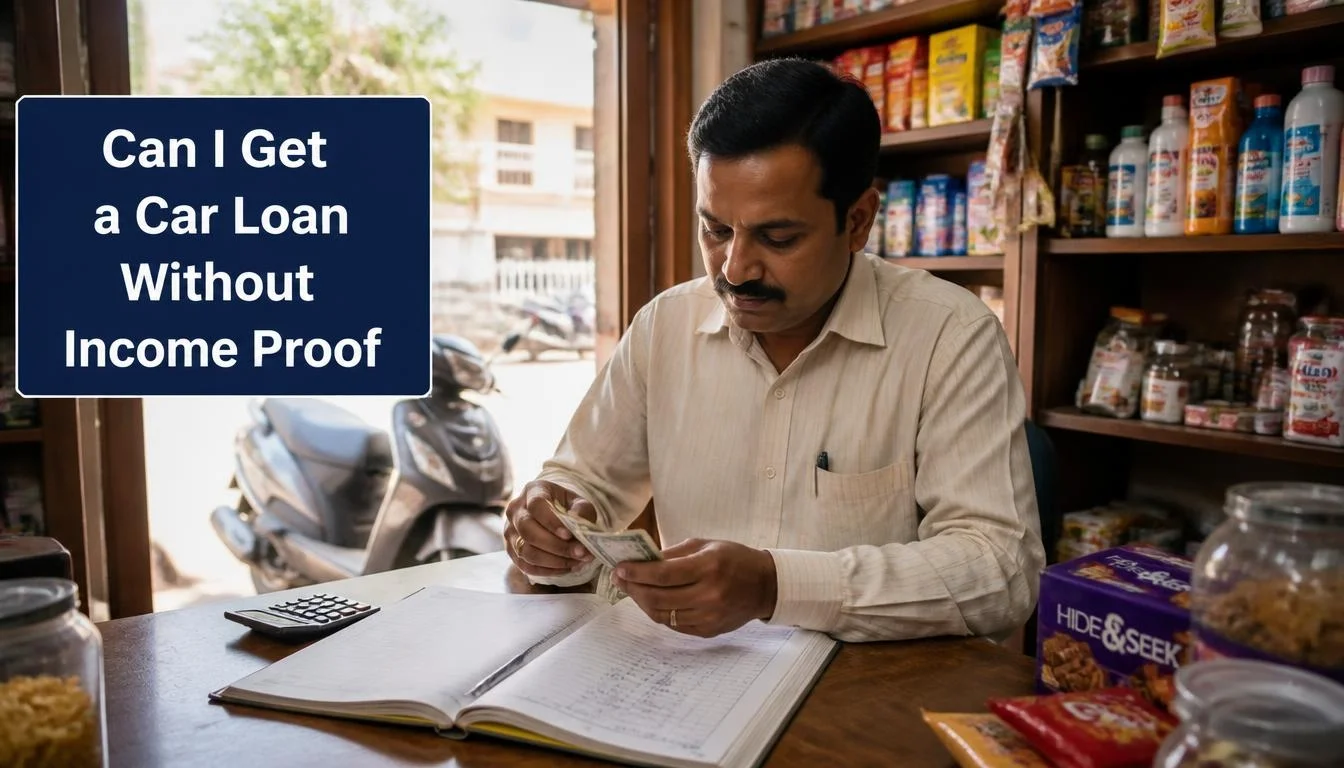
You have found the car you want and saved for a down payment. Then the lender asks for salary slips or income tax returns — and you do not have them in the usual form.
Can you still get one? It is difficult, but not always impossible. It depends on your profile, the lender, and what other evidence you can provide.
Why Do Lenders Ask for Income Proof?
A car loan is a secured loan, so the car itself acts as security. Even so, if you stop paying, the lender must recover and sell the car, which takes time and money. Income proof helps the lender check whether you can afford the EMI, whether your income is stable, and whether your details match across records.
Most banks and NBFCs ask salaried applicants for salary slips for the last three to six months, bank statements, and sometimes Form 16. Self-employed applicants are usually asked for income tax returns for the last two to three years, business bank statements, and proof of business.
That does not mean there is no path forward without these exact documents. It does mean you will need to show repayment ability in another credible way.
When Is Income Proof Hard to Provide?
Many genuine borrowers struggle with standard income proof:
Cash or irregular income: You may earn well from a shop, farm work, freelancing, or a family business, but much of it may be received in cash or in irregular payments.
A new job: You may have just started work and do not yet have three to six months of salary slips.
Self-employed with low declared income: Your actual cash flow may be higher than the income shown in your tax returns, especially in the early years of a business.
No income in your own name, or gig work: A homemaker, student, driver, or contract worker may have no employer to issue a salary certificate, even if the household earns well.
If any of these apply, do not hide the situation. Misrepresenting income can lead to rejection and serious problems later.
What Might Lenders Accept Instead?
There is no guarantee, and policies vary widely. But lenders may look at one or more of these alternatives:
Bank statements: Six to twelve months of statements showing regular credits can help. Steady deposits, a healthy average balance, and no frequent cheque bounces work in your favour.
Income tax returns: Even one or two years of returns can support your case if you are self-employed.
Business proof: A GST registration, business licence, or shop ownership proof may help show that the business is real and active.
A co-applicant: Adding a co-applicant with a stable income — for example, a spouse or parent — can strengthen the application. The co-applicant becomes equally responsible for repayment.
A higher down payment: Paying more upfront reduces the loan amount and the lender’s risk. For example, paying 30 to 40 percent instead of 10 to 20 percent may make a lender more willing to consider the case. This is not a promise of approval, and you should only do it if you can afford it without wiping out your savings.
A lower loan amount: A smaller loan, or a cheaper car, means a lower EMI and lower risk for the lender.
Some NBFCs and dealer finance partners may have more flexible rules than large banks, but that flexibility often comes with higher costs, covered below.
Options You Can Explore
Apply with your own bank first. It can see your transaction history and may be more comfortable with your profile.
Talk to an NBFC or dealer finance desk. They sometimes accept bank statements and alternative documents. Compare at least two or three offers before choosing.
Add a co-applicant. A parent or spouse with salary slips or tax returns can improve eligibility, but discuss the responsibility openly. Missed payments will affect both credit scores.
Increase the down payment or choose a lower-priced car. Reducing the loan amount is often the simplest way to improve your chances.
Wait and build a paper trail. Deposit your income regularly for three to six months, file your tax return, and then apply. Avoid agents who promise guaranteed approval for a fee — that is a common red flag.
Risks and Higher Costs to Watch For
A loan without standard income proof, if approved at all, is often more expensive. Watch for:
Higher interest rate: The lender may charge a higher rate to cover the extra risk. Even a 1 to 2 percent higher rate can add a large amount of interest over five years.
Shorter tenure or lower amount: The lender may offer a shorter tenure, which raises the EMI, or approve less than you asked for.
Extra charges: Check processing fees, prepayment charges, and any insurance or add-ons bundled with the loan. Ask for the total cost in writing.
Pressure to misrepresent income: Never submit fake salary slips, inflated returns, or false employment details. This can lead to loan recall, legal action, and a damaged credit history. Always compare the total cost, not just the EMI.
Practical Steps to Strengthen Your Application
These steps do not guarantee approval, but they improve your profile:
- Deposit income regularly and keep a healthy average balance, with no bounced cheques or failed EMIs.
- Check your CIBIL score and credit report for errors, and correct them before applying.
- Keep existing loans and card dues low, pay them on time, and apply for only one or two loans at a time.
- Keep KYC documents updated and consistent, and keep Aadhaar, PAN, address proof, and bank statements organised.
- Save a larger down payment if possible, without using all your emergency funds. Filing tax returns regularly also builds a verifiable record over time.
Frequently Asked Questions
Can I get a car loan with no income proof at all?
It is very difficult. Most lenders need some evidence of repayment ability. Bank statements, tax returns, a co-applicant, or a higher down payment may help, but there is no approval without any assessment.
Can I get a car loan if I earn in cash?
Possibly, if you can show that income through bank deposits and statements over several months.
Will a co-applicant help if I have no income proof?
Yes, in many cases. A co-applicant with stable, documented income can improve eligibility, but both applicants are responsible for repayment.
Do NBFCs give car loans without income proof?
Some NBFCs have more flexible documentation than banks, but they still assess income and risk, and may charge a higher rate.
Is it safe to use an agent who promises a loan without documents?
No. Anyone who guarantees approval for a fee or asks you to submit false documents can cause rejection, fraud, and long-term damage to your credit record.
Conclusion
Getting a car loan without standard income proof is harder, but it is not always a closed door. If you can show repayment ability through bank statements, tax records, a co-applicant, or a larger down payment, some lenders may consider your application. Build a clear financial record, choose an amount you can comfortably afford, compare offers, and read the full loan terms before signing.
Disclaimer: This article is for educational purposes only, not financial advice. Eligibility, documents, rates, and terms vary by lender. Check current terms with your lender and never misrepresent your income or documents.









