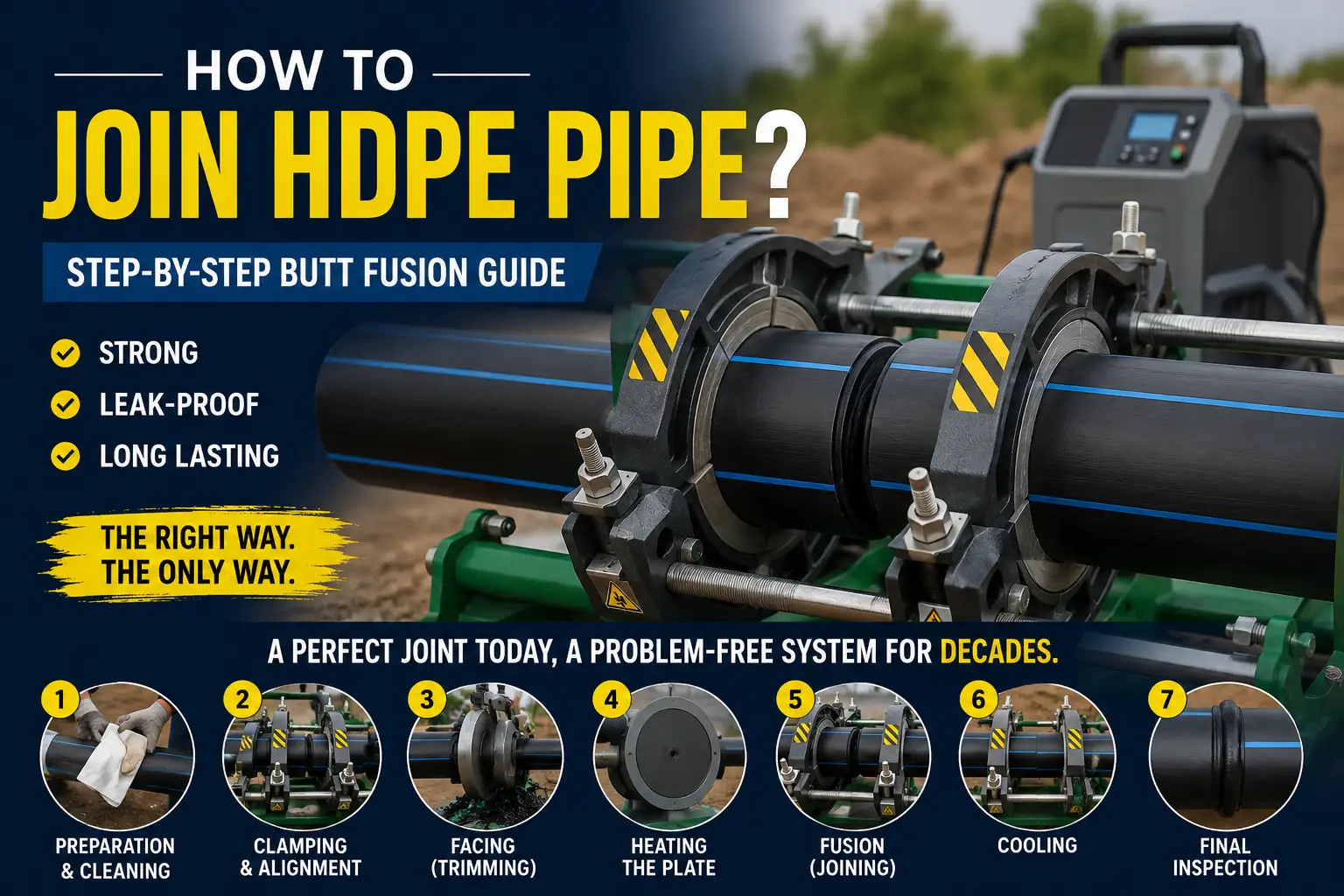
If you’re wondering how to join HDPE pipe, the most reliable and widely accepted method is butt fusion. When performed correctly, the joint becomes as strong as the pipe itself, creating a leak-proof connection that can last for decades. Whether you’re installing a water supply line, gas pipeline, or industrial piping system, using the correct joining technique is essential for long-term performance. In this guide, we’ll explain the complete butt fusion process, what HDPE pipe is, where it’s used, and answer the most common questions about HDPE piping.
What Is HDPE Pipe?
HDPE (High-Density Polyethylene) pipe is a durable thermoplastic pipe known for its high strength, flexibility, corrosion resistance, and long service life. Unlike metal pipes, HDPE does not rust or corrode, making it suitable for underground and above-ground installations.
Because of its excellent chemical resistance and flexibility, HDPE is widely used in municipal water systems, gas distribution networks, irrigation, mining, drainage systems, and industrial pipelines. HDPE pipes can also be joined through heat fusion methods, creating permanent leak-free joints without adhesives or rubber seals.
How to Join HDPE Pipe (Step-by-Step Butt Fusion Process)
Based on practical field experience, butt fusion remains the preferred method for joining pressure HDPE pipes. When completed correctly, the finished joint becomes a single continuous pipe.
1. Preparation and Cleaning
Start by inspecting both pipe ends carefully. Check for:
- Cracks
- Deep scratches
- Out-of-round (ovality)
- Damaged pipe sections
Remove any damaged portion before beginning.
Clean both the inside and outside of the pipe ends using a lint-free cloth and 99% isopropyl alcohol. Even small amounts of dirt, grease, or moisture can reduce weld quality.
2. Clamping and Alignment
Secure both pipe sections firmly in the butt fusion machine clamps.
Allow approximately 3–5 cm of pipe to extend beyond the clamps so the facing tool has enough working space.
Bring both pipe ends together and verify there is no misalignment. The inside walls should align perfectly. Adjust the machine’s alignment bolts until both pipes are centered.
3. Facing (Trimming)
Insert the facing tool between the pipe ends and trim both surfaces until they become perfectly flat and parallel.
Remove any plastic shavings before moving to the heating stage.
4. Heating the Pipe Ends
Clean the heating plate before every fusion.
Heat the plate to approximately 220°C (or according to the pipe manufacturer’s recommended fusion temperature).
Place the heater between the pipe ends and apply the specified pressure until a uniform melt bead develops.
5. Fusion (Joining)
Open the clamps carefully.
Remove the heating plate quickly without touching the molten surfaces.
Immediately bring both molten pipe ends together using the specified fusion pressure.
Proper timing is critical because the plastic begins cooling immediately after the heater is removed.
6. Cooling
Maintain constant joining pressure throughout the cooling cycle.
Do not move the pipe or remove it from the clamps while the joint remains hot.
Premature movement can weaken the weld and reduce its service life.
7. Final Inspection
Once fully cooled, remove the pipe from the machine.
Inspect the weld visually.
A successful butt fusion joint will have two uniform, symmetrical fusion beads around the entire circumference.
If the bead appears uneven, incomplete, or irregular, the joint should not be accepted.
How Is HDPE Pipe Most Commonly Joined?
Although several joining methods are available, butt fusion is the most common for pressure HDPE pipelines because it produces a permanent, homogeneous joint.
Other joining methods include:
- Electrofusion
- Socket fusion
- Saddle fusion
- Mechanical compression fittings (mainly for repairs or smaller installations)
The choice depends on pipe diameter, working space, application, and project requirements.
What Is HDPE Pipe Used For?
HDPE pipe is used in numerous industries because it combines durability with excellent chemical and corrosion resistance.
Common applications include:
- Drinking water supply
- Municipal water distribution
- Sewer systems
- Natural gas pipelines
- Agricultural irrigation
- Mining slurry transport
- Industrial chemical pipelines
- Fire protection systems
- Electrical cable protection
- Telecommunications conduits
- Stormwater drainage
Its flexibility also makes it suitable for trenchless installations and areas with unstable soil conditions.
HDPE Corrugated Pipe
HDPE corrugated pipe features a corrugated outer wall that provides high ring stiffness while maintaining a lightweight structure.
Unlike standard pressure HDPE pipe, corrugated HDPE pipe is mainly designed for gravity-flow applications rather than high-pressure systems.
Benefits include:
- Lightweight installation
- Excellent impact resistance
- High structural strength
- Corrosion resistance
- Long service life
- Low maintenance
Corrugated HDPE Pipe Applications
Corrugated HDPE pipe is commonly installed for:
- Highway drainage
- Stormwater management
- Culverts
- Agricultural drainage
- Land drainage
- Railway drainage
- Construction site drainage
- Rainwater harvesting systems
Its ability to withstand soil loads while remaining lightweight makes it a preferred drainage solution.
Common Mistakes to Avoid During HDPE Pipe Joining
Even experienced installers can make mistakes that reduce joint quality.
Avoid these common errors:
- Skipping pipe cleaning
- Poor pipe alignment
- Incorrect heater temperature
- Touching molten pipe surfaces
- Removing pressure before cooling finishes
- Accepting an uneven fusion bead
Following the recommended fusion procedure significantly improves weld quality and long-term reliability.
Frequently Asked Questions
Can HDPE pipe be glued?
No. HDPE cannot be reliably joined using conventional PVC adhesives. Heat fusion methods create the strongest permanent joints.
Is butt fusion stronger than mechanical fittings?
Yes. A properly completed butt fusion joint is generally considered as strong as the original pipe itself.
Can HDPE pipe be joined in the field?
Yes. Portable butt fusion and electrofusion equipment allow HDPE pipe to be joined directly on-site.
How long does a butt fusion joint last?
When installed correctly and operated within design limits, HDPE fusion joints are designed to provide decades of reliable service.
Conclusion
Learning how to join HDPE pipe correctly is essential for building reliable pipeline systems. Among all available joining methods, butt fusion remains the industry standard because it creates permanent, leak-proof joints with strength comparable to the pipe itself. By following proper preparation, alignment, heating, fusion, cooling, and inspection procedures, installers can achieve durable connections that perform reliably for many years.